We have been working closely with current users and did extensive riding tests in order to optimize the design for the new JZ88 (call it Mark2). The most popular requests are: smaller, lighter, cheaper, faster and more comfortable. Problem is, many of these requests are contradictory in reality, for example, there are stronger material such as titenium to make the bike lighter but that would cost a lot more. We can install a more comfy seat but that would make the bike heavier.
What will the Mark 2 looks like? What is your view?
Cycling declines in Asia, on rise in Europe
Bicycle ownership and use has been declining in China and India, while Europe is at the forefront of measures to popularise cycling. Here are some comparisons:
OVERVIEW
There are some 1.6 billion bicycles in the world, 500 million of them in China, 250 million in Europe and 150 million in the United States. China and India are the world’s largest producers of bicycles. China manufactured about 80 million bicycles in 2005, accounting for about 60 percent of global production while India’s share was around 11 percent. The global bicycle industry, including bicycles, parts and accessories, is estimated to have total retail sales in excess of $20 billion.
CHINA AND INDIA
Annual bicycle sales in China have fallen from 40 million in the 1990s to 20 million. Bicycle ownership in India is down from about 45 million in 1995 to 31 million. The proportion of trips undertaken by bicycle in India is between 15 percent and 35 percent, but cycling is popular mostly in rural areas. The absence of safe cycling paths and parking facilities are the major obstacles. Sixty percent of the workforce in China’s capital Beijing cycled to work in 1998; that is down to less than 20 percent now. Hundreds of bike lanes in Beijing have been converted for use by cars.
EUROPE
In the European Union, bicycles have been included for the first time in the comprehensive transportation plan. High car parking fees and abundant bike lanes have ensured that 35 percent of local trips in Amsterdam are made by bike. The percentage is even higher in other Dutch and Danish cities, according to Dutch figures. The United Kingdom has developed a plan to quadruple bicycle use by the year 2012. The Danish capital Copenhagen provides 3,000 bicycles free for short-term use. One-third of commuters bike to work. Germany has more than 40,000 km of bikeways. In the city of Muenster, bus lanes can be used by bikes but not by cars and special lanes near intersections feed cyclists to a stop area ahead of cars.
Sources: Reuters; International Bicycle Fund (www.ibike.org); Earth Policy Institute (www.earth-policy.org); Worldwatch Institute (www.worldwatch.org) ((Writing by Bangalore Editorial Reference Unit; editing by Megan Goldin Reuters Messanging: Karthik.subbaraman.reuters.com@reuters.net; +91 80 4135 5900, fax +91 80 4135 5001))
20 Dec 2006 18:03:54 GMT
Source: Reuters
Jz88 featured in Reuters – Singapore fold-up bike goes against Asian tide
20 Dec 2006 13:03:45 GMT
Source: Reuters
By Gillian Murdoch SINGAPORE, Dec 20 (Reuters) –
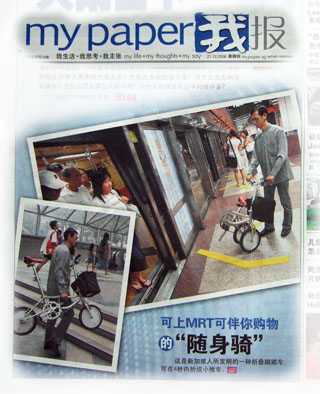
JZ88 folding bike in MRT, shopping halls
Chu Wa feels the small thrill of breaking Singapore’s notoriously strict rules and getting away with it every time he wheels his pretend “shopping trolley” through a shopping mall or along a train platform.
The contraption is actually a fold-up bicycle, which Wa designed to look like a shopping cart so he could take it through the many prohibited zones in the city state.
“Singapore is absolutely not fair for cyclists,” said the 46-year old product designer.
After years of biking to work in the Netherlands, Wa gave up and bought a car when he moved to Singapore, finding its motorways and shopping malls bike-unfriendly.
“If you love cycling in Singapore, you have to accept the status of a secondary citizen, many places are ‘restricted zones’ and you are simply not welcome,” he wrote on his blog, www.jz88.com.
At the same time as European cities are back-pedalling from cars to bikes in a bid to clean the air and ease congestion, rising affluence has seen bikes ditched from Beijing to Bangkok. Bikes have been banned from parts of Shanghai as have bike rickshaws in Dhaka, and bikers in Jakarta and Bangkok have mounted protests to campaign for better facilities.
The lack of top-level support makes returning to cycling more difficult than it should be, said Wa, who had five regular bikes stolen from unguarded bike stands in Singapore.
His solution? The JZ88: a thief-proof bike that flips from shopping trolley to cycle in 8.8 seconds.
With a shopping bag strapped over its handlebar, and spokes concealed under clear plastic shields, Chu’s folding bike goes everywhere he does. Weighing nine kilograms (20 pounds), it is small enough to fit under train seats and in taxi boots.
Shoppers stare as he loads groceries into his trolley, and pedestrians sometimes laugh as his long legs pedal the little wheels. But Wa says his bike is more than a gimmick.
“My ideal is to see more Asian cities become bicycle friendly … The hurdle is so high, in terms of road safety, too much effort, or bad weather, that even the authorities can’t do much,” he said. “(But) the folding bike can be a bridge”.
——————————-
To read more:
http://www.alertnet.org/thenews/newsdesk/SP281228.htm
Related posts :
 Bicycle? no, it’s a shopping trolley
 Traveling with folding bike
 3 modes of Jz88 (Bike, Trolley, Carry)
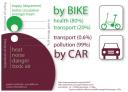 less than 1%
It’s so small, I was a bit skeptic at first..
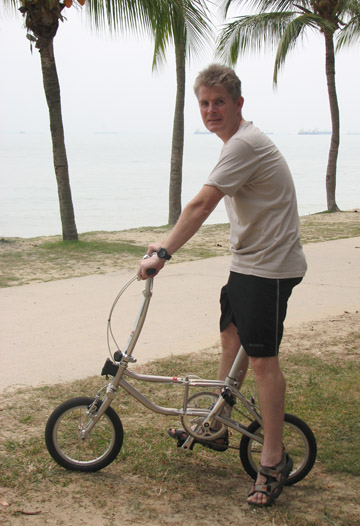
I am a Norwegian PhD student visiting Singapore for one year. In Norway I use my bike nearly every (working)day for commuting.
My ambition was to do the same when I came to Singapore, but my first Taxi-trip convinced me that biking in Singapore could be dangerous.
In Norway I am used to use dedicated lanes for bikes, or at least one that we share with the pedestrians, but here in Singapore there are not many signs of anyone wanting people to use bikes for commuting without risking their lives. So I kind of gave up my ambition of using bike.
But then I by accident came over a web-site selling foldable bikes, the JZ88. Not only did they sell it, but I could try it out for the fist month for 50 SGD, so I jumped on the offer.
I must admit I was a bit skeptic at first when I saw the bike, it looked small, maybe too small ?
But, it was no problem adjusting the bike to my size (I must admit I am not the biggest person around, 175/75).
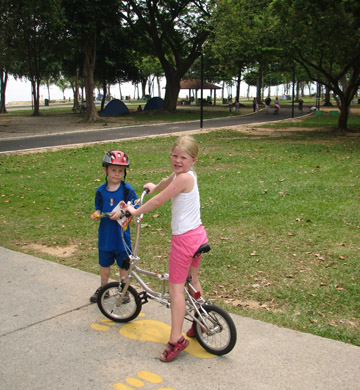
It is also easy to adjust the bike so it fits my two children, who are 6 and 8 years old, so it is a very versatile bike.
.
After a short while I was able to fold/unfold the bike in about 15 seconds, and the weigh of about 8,5 kg makes it easy to carry in to the MRT.
It is also easy bring it up to my apartment at the 4.th floor, so I don’t need to worry about anyone stealing it (does anyone steal anything here in Singapore ?).
As a bike, the JZ88 is just what it pretends to be: It is perfect for commuting. If you plan to go on a long bike-ride, I guess there are better choices.
But if you are planning on using it like me, From home to the MRT-station, and from the MRT-station to work (or whatever), it is perfect.
It is easy to use on the narrow pavements of Singapore, without coming in conflict with the pedestrians, the speed is OK, but not too high.
It has just one gear, and this is OK for most of the “hills” of Singapore. You just can’t get to much speed downhill.
The compact size after folding makes it so easy to bring along. Occasionally we take a Taxi to East Coat Park, and bring the bike in the trunk of the Taxi. No problem at all.
Then we take turns on using the bike, it fits the whole family.
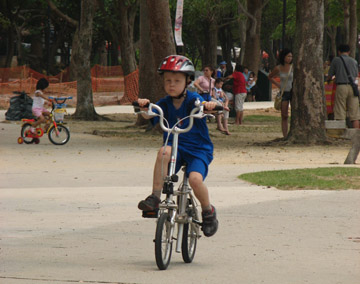
I have been approached by a lot of people in Singapore when using the bike, many of them seem to like it. And I have to tell that I really love it.
So my recommendation : check out the JZ88. You can “ test it out for two weeks, risk free “(well nearly, it will only cost you 30 SGD, but you will love the bike, so don’t be afraid).
Other related posts:
– Bicycle? no, it’s a shopping trolley!
– Traveling with folding bike
– Jz88 folding bike home
Biking city is healthier city at lower cost
A short and sweet artice about the ROI (Return On Investment) of biking in city. I certainy hope Singaporean (gov. & ppl) wake up to this overlooked opportunity to improve Singapore even better.
Here are a few quotes:
“Odense Cycle City, an ongoing, multi-million kroner effort to improve conditions for bicycle commuters, is proving to be a good investment.”
“The programme cost the city DKK 20 million (EUR 2.68 million) and has transformed Odense into one of Denmark’s most bike friendly cities, increasing the number of two-wheeled commuters in the city of 186,000 by an estimated 25,000 per day.”
“Odense estimates that over the past four years, a decrease in the number of sick days has saved DKK 33 million (EUR 4.4 million) in health service costs and unemployment benefits.”
read more:
Biking helps cut down on sick days