Only less than 1% of the gasoline you pay end up bring you from A to B.
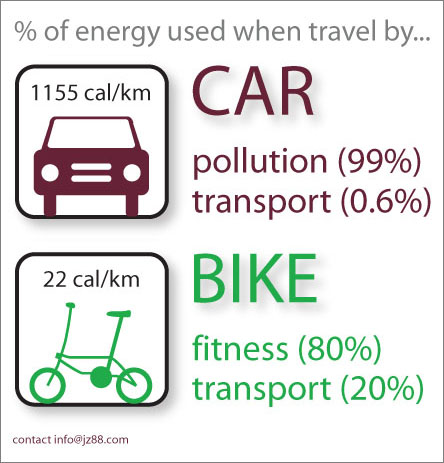
This sounds ridiculous. But figures from US government site convinced me exactly that. it shows the energy used and losses of typical car: 64% of fuels wasted as engine losses, 17.2% wasted during standby and idle time, 5.6% lost within the drive-train. In the end only 12.6% is really “used” for moving the car from A to B. Suppose a typical car weights 2000kg and the passenger weights 100kg, then only 1/20 of the 12.6%, or 0.63% is really useful for moving the passenger.
–

–
I couldn’t believe it considering the motor industry has been around for so long and appears to be “advance” in many way. It must be a collective hypnoses that get us all believe this kind of fuel wastage is OK.
What does the rest of the 99% do?
–
Polluted air, traffic noise, heats, road danger-splitting up community space and occasional road kills and injuries. A car is a 99% polluter!
–
–
What about bicycle?
Bicycle is known to be the most efficient device to move people around. However, human body is not so good in converting food (fuel) into mechanical energy. Only 20% of the food energy is used in peddling, but still, this is 20 times smarter (more efficient) than driving.
–
What does the 80% energy do when we cycle?
–
Stronger heart beat, better circulations, increase endorphin (feel good), reduce fat. In other word all the “waste” energy goes into improving the rider’s fitness.
–
Consider stop driving for a change and to cycling for a while. You will be 20 times smarter in using the energy, improving your fitness and reducing huge amount of pollution all at the same time!
–
data source:
http://www.worldwatch.org/node/4057
http://www.fueleconomy.gov/feg/atv.shtml
–
assumption:
car = 2000kg, passenger = 100kg
human metabolic efficiency (paddle energy/food energy) = 20%
nice one.
i think the reality may be 0.1% of what you pay for your car actually bring you around. i am talking about the real fuel (money). in singapore, gas is only a small fraction of the total cost of using a car.
shimpa