Key concept for safer cycling in Singapore:
Remember you are invisible to cars.
Find a quiet route, mode share if necessary.
Be adept and confident in your bike handling skills. Cycle to your ability.
Ride in the middle of the lane at intersections. When turning right, filter early, or do a hook turn. Use hand signals.
Watch and allow space for car doors opening.
Use the footpath and pedestrian crossings if you feel the need to. Always give way to pedestrians and cycle at walking pace.
Remember you are invisible.
Singapore roads do not currently have separated lanes for cyclists, as many other countries do. In any collision between a cyclist and a car which is traveling at more than 30km/hr, the cyclist is likely to be killed or seriously injured. Never assume you are safe because wearing a helmet. Bicycle helmet is designed to protect (the top of) your head for impact at 20km/h if you are falling off from the bicycle. There are 120 over road fatalities every year, 10-15 of which are cyclists. I use the following strategy to avoid being involved in such accidents.
The principle is called “Defensive bicycling”. It is a strategy that can increase your safety margin.
First, assume that drivers haven’t seen you (e.g. they may be illegally talking on the phone, busy to overtake from the slow lane, or just not paying attention). Ride as if you are invisible.
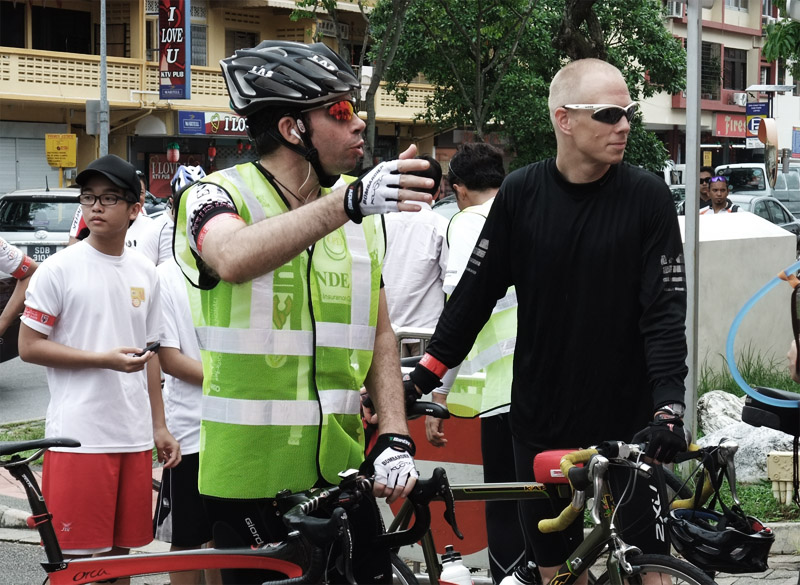
Accordingly, make yourself very visible on the road to give drivers the best opportunity to notice you earlier, which allows them to share the road safely with you. Wear brightly colored clothing, put on a brightly colored cap or helmet, ride in a predictable manner. By law you have to Install bright front (white) and rear (red) lights if you ride at night. But, never forget point 1, ALWAYS ride as if you are invisible.
But don’t think you are safe yet, read on.
There are 6 factors affecting the safety of cyclists on Singapore road. Two of them: the design of the roads, and drivers’ behavior are not in cyclists’ control. But you can use the other 4 factors to improve your chances of survival.
1. Your route choice
Your route choice can drastically affect your safety and the overall cycling experience. Take some time on a weekend to explore alternative, quieter routes, such as cutting through HDB estates, crossing major roads at pedestrian crossings, and using Nparks’ park connectors. It will be much more pleasant than ‘fighting’ traffic, and often the total journey time is only slightly longer. Google Maps is a great help.
If you need to cover a long distance and can’t avoid dangerous roads, consider combining your cycling with the MRT or Bus by using a folding bike or locking your bike at the station. You can almost always find a safe route to your nearest Bus or MRT station from within most estates.
2. Your skill and attitude
As with a car, you need to be in complete control of your bike at all times. Can you turn your head to check over your shoulder and keep steering a straight line? Can you give hand signals without losing control? Can you execute an emergency stop (without skidding the rear tyre or flipping over your handlebars)? Can you avoid an obstacle (such as a pothole) while cycling at speed? If not, practice in a park before venturing onto the road. Make sure you have the right attitude; arriving safely is more important than arriving quickly. Needless to say, don’t cycle when drunk.
3. Your awareness
– Most traffic accidents occur at intersections. Pay special attention when riding through intersections, and be aware of left-turning cars turning into you (this is called a “left hook”). Take the entire lane when approaching an intersection to prevent turning cars cutting into you. When turning right, filter early into the right turn lane, or perform a hook turn – proceed through the intersection and once on the far side join the left most lane of stationary traffic and wait for the green light.
– Being predictable makes it easier for drivers to give you sufficient space. Avoid sudden changes of direction. Riding in a straight line in one lane is safer than darting in and out around obstacles, such as parked vehicles.
– When riding adjacent to parked cars, be sure to leave enough space for drivers opening their car doors without looking by riding a bit further out. If you are hit by a door you will either be spilled out into traffic or go over the handlebars.
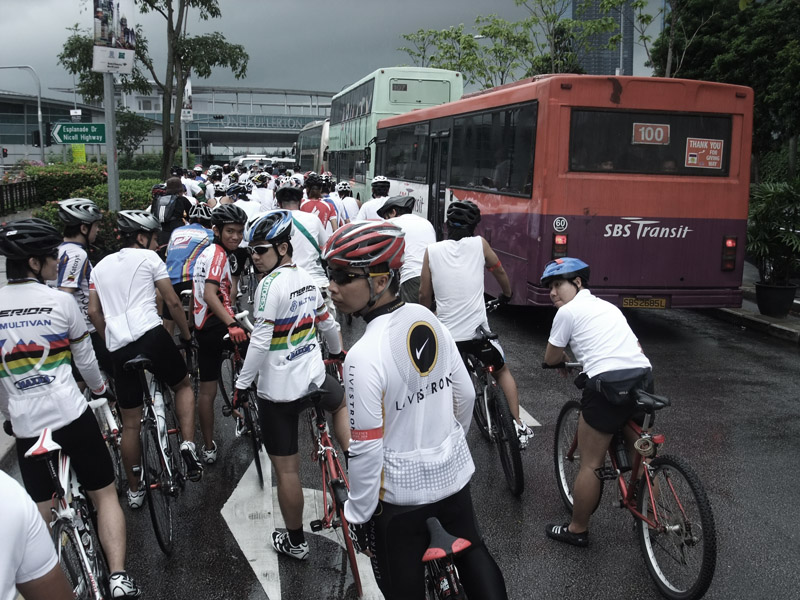
– Roads in Singapore are designed for car speeds well over the 50-80km limit (e.g. Toa Payoh Lorong 1), and drivers will drive over the speed limit, despite its illegality. Cyclists are at risk due to the large speed differential, so ride on the footpath if you have to to stay safe.
– Riding opposite to traffic direction (like a salmon swimming upstream) is much more dangerous than it appears, because the speed difference is even greater and drivers don’t have any time to react if anything unexpected happens.
– Be aware that drivers are not actively looking for you. Remember you are invisible.
– Footpaths are a safe haven if the road gets too dangerous, eg. on a 3 or 4 lane arterial road or when heavy rain reduces traction and visibility. However, you must respect the right of way of pedestrians, and be able to cycle at walking pace without wobbling or losing control. Be polite and courteous. Also be extremely careful when merging back onto the road. Drivers are not skillful enough to react if you dart out suddenly. Also look for turning cars when crossing sidestreets on the footpath – a major cause of “left hook” accidents.
– Smaller roads (single lane both directions) are usually much safer than main roads, but you still need to be alert for cars entering from side streets without looking.
– Don’t trust road signs and traffic light signals as many drivers will “roll through” a stop sign, and many others try to “beat the lights”. Make sure no driver is in a possible position to hurt you before crossing the intersection. For example, if the traffic green man is on but a car is still approaching the crossing, I wait until the car slows down and stops before I start to cross. The same applies when you are a pedestrian.
4. Your bicycle
Your bicycle should be in good working condition with functioning front and rear brakes, fitted with front and rear lights if you need to cycle at night. Remember you are invisible.
Finally the last two factors that you can’t control, yet it is essential to know.
5. Road design
Road infrastructure in Singapore is world class – for automotive. Unfortunately in some cases it is at the expenses of non-motorized road users, including cyclist and pedestrian. Wide lanes, straight roads, turning designed at large radius in densely populated area often encourage drivers to drive beyond the legal speed limit. Due to the road and traffic light design it is normal to see drivers speed through the straight segments between the traffic lights, only to find themselves waiting frustratingly at the next traffic lights a couple of seconds earlier.
6. Driver’s behavior
Most drivers are of good nature and courteous. However there are some very dangerous odds. A few common “habits” that can turn a seemingly harmless driver into a deadly killer:
– Speeding: 10km is “OK”. 50km/h is already way too fast for most of the urban area, many drivers consider driving at 60km/h is still acceptable.
– Poor lane discipline: Overtake from the slow lane, or worst, illegally using the bus lane as overtaking lane: The attention of the overtaking driver is on the right hand side, so it is very possible he/she won’t see the cyclist on the left.
– Multi-tasking: SMS, phoning, or checking the map while driving.
– Not stopping/ slow down when approaching junction, zebra crossing or pedestrian crossing.
– Not giving enough space for cyclist when over taking.
– Cutting into cyclist path when turning.
– Drunk driving, or driving when one is too tire.
The combination of factor 5 and 6 makes some of the roads in Singapore more deadly than it is necessary. However, knowing these factors and actively avoiding such roads helps to increase your safety as a cyclists significantly.
Thanks to my friend Tom, this is an improved version of my original post back in 2009