Category Archives: cycling general

general issues relates to cycling

New Share Bike scheme in Taipei

YouBike bicycle
YouBike bicycle

A new public bike scheme is started by the Taipei goverment and supported by Giant bicycle in Taipei. Bicycle is already a clear growing trend all around the world. It is a symbol of advanced, civic and a green city. The cycling population in Taiwan is growing rapidly acrros all ages.

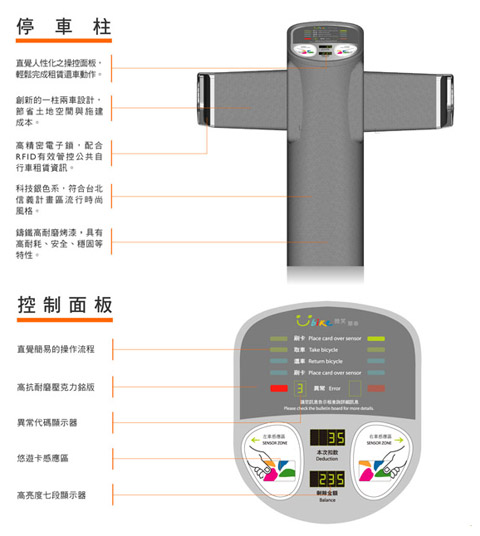
YouBike Stop and Control panel

The ambition of the project is to promote the use of bicycle as the “last mile” connection for public transportation. This encourage a new commuting culture to let more people to take public transport. Increase transport efficiency while reducing the energy consumption. as the same time.

The YouBike system is controled by automated electronic system, using RFID and smart card system.

The YouBike Public Bicycle System uses the EasyCard as the membership card. Short-term card registration is available from the information kiosk at each rental point. Long-term card can be applied via the YouBike website or service center.

First 30 minutes of each session is free then $10 for each additional 15 minutes.

Some statistic:
Automated bicycle station: 11
RFID tagged parking space: 754
YouBikes: 500
Service center: 1

Cycling safe in Singapore roads

Singapore road doesn’t have allocated space for cyclists. In any accident involving cyclist and car, the cyclist will be most likely to be killed or seriously injured. There are 120 over road kills every year, 7% of them involve cyclists. I use the following strategy to avoid being involve in such accidents.

The principle is call “Defensive bicycling”. It is a strategy that can increase your safety margin.

First, don’t assume ALL drivers can see you (e.g. they may be talking on the phone..). Second, make yourself very visible on the road so that MOST drivers notice you earlier which allows them to keep a distance from you.

To increase your visibility, dress in bright color cloths, put on a bright color cap or helmet, ride steadily along the road. Install bright front and rear lights if you need to ride at night. But don’t think you are safe yet, read on.

There are 6 factors affecting the safety of cyclists on Singapore road. Two of them: the design of the roads, and driver’s behavior are not in cyclist’s control. But you can use the other 4 factors to improve your chances of survival.

Your route choice
Your route choice can drastically affect your safety and your experience of Singapore. Take time to explore alternative routes, it will be worthwhile.
If you need to cover a long distance and can’t avoid dangerous roads, consider combining your cycling with MRT or Bus by using a folding bike – you can always find a safe route to your nearest Bus or MRT station.

Your skill and attitude
You need to be in complete control of your bike. If you are riding on the road, can you turn your head to check over your shoulder and keep the steering steady? Can you give hand signals without losing control of your bike? If not, practice in a park before venturing on the road.
Attitude, always consider safety ahead of speed.

Your awareness
– Most of the traffic accident occur at the road junctions. Pay special attention when crossing the junctions. Or better, cross the road at other points and avoid the junctions all together.
– Being predictable make it easy for drivers to keep a distance from you. Avoid sudden changes of direction. Riding in relatively straight lines is safer than darting in and out around obstacles, such as parked vehicles.
– Take the lane when traffic is slow at the junction to prevent turning cars cut into your lane.
– Some roads in Singapore are design for car speed well over the 50km limit (e.g. Toa Payoh Lorong 1). Slower cyclists will be more at risk due to the speed differences from the fast moving traffic passes by.
– Riding opposite to traffic direction is much more dangerous than it seems, because the speed difference is even greater and the drivers sure don’t have any time to react if anything happen unexpectedly.
– Drivers may be distracted behind the wheel. Keep an extra safe distance.
– Pavements is a safe haven if the roads gets too dangerous. However, do respect the right of way of pedestrian. Also be extremely careful when merge back into the road. Driver can not react if you come out suddenly.
– Side streets are usually much safer than main roads, but you still need to be alert for cars coming from the sides.
– Don’t trust the road signs and traffic light signals 100%, some drivers may be distracted and not following completely. Make sure no driver is in a possible position to hurt you before crossing the road. For example, if the traffic green man is on but a car is still approaching the crossing, I will wait until the car slows down and stop before I start to cross.

Your bicycle
Your bicycle should be in good working condition with good brakes. Fitted with front and rear light if you need to cycle at night.

Cycling in heavy traffic is unhealthy?

Sometime we hear that cycling in heavy traffic is unhealthy, more so than driving a car. To test this hypothesis, teams of two cyclists and two car drivers in two cars were equipped with personal air samplers while driving for 4 h on 2 different days in the morning traffic of Copenhagen. The air sample charcoal tubes were analysed for their benzene, toluene, ethylbenzene and xylene (BTEX) content and the air filters for particles (total dust). The concentrations of particles and BTEX in the cabin of the cars were 2–4 times greater than in the cyclists’ breathing zone, the greatest difference being for BTEX. Therefore, even after taking the increased respiration rate of cyclists into consideration, car drivers seem to be more exposed to airborne pollution than cyclists.
link

Mini-roundabout or cross junction?

Just found this excellent video from Youtube showing an innovative idea, may be strange to Singaporean but quite common in Europe, call a mini-roundabout.
The idea is counter intuitive for those who are used to follow the traffic lights at traffic junction. The idea of mini-roundabout to resolve conflict at traffic junction is based on the same principle as indicated in yesterday’s post (Vision Zero), that in locations with possible conflicts between pedestrians and cars, the speed of cars should be reduced to below 30km/h. Here the system designer is not relying on traffic signs and speed camera. It is the physical environment design that ensure when cars approach the roundabout, their speed will have to be reduced to below 30km/h.

How does the system designer do that?
1- by making the roundabout small in size. When car need to make a small turn, they have to slow down.
2- by ensuring open visibility of on coming traffics from all direction, that provide time space for the drivers and other road users to negotiate with each other.
3- by marking the road so that it is very narrow as approaching the junction- this provide a safety-island for pedestrians who need to cross, and at the same time further ensuring the cars are slowing to a safe speed.

All of the above factors contributed to the effectiveness of the solution, no traffic light, nor even signs. The principle is to remove the traffic signs so that the drivers can focus on the road and other road users to ensure safety of everyone.

Since there is no traffic light to control the traffic, the surprising result is that the traffic flow is better and safer around such sign-less junctions. Here is another example comparing two types of junction:

Here is another Youtube video showing some car accident on traffic camera. It shows how dangerous cross junction can be due to difference in speed, even in safe Japan. I feel really sad for the little kid cycling cross a small road and got crashed by a car. This is exactly the kind of situation system designer can helps to avoid by designing the space right for human being, not just for automotive.

Yet another example from Holland, this time showing how a cyclist safely ride through (from far left to far right, from 11 sec. onward) the roundabout and many moving cars without a single stop.