Category Archives: cycling general

general issues relates to cycling

Cycling as a form of health insurance

My daily commute by bicycle is the best health insurance I can think of. No insurance policy can guarantee my health in the future, at best insurance can only cover the medical cost when my body goes wrong. Such scenario is far from desirable, I don’t want to get pay because of getting sick, I want my health.

On the contrary, pedaling my bike is promoting the critical circulation systems in my body, bringing the essentials to where they are needed and at the same time, carrying the waste out of my body (sweating is good for me!). Statistically speaking, my body condition is similar to those 10 years younger. I can enjoy different types of food, I can enjoy to play catching with my kids while others of my age would rather watch.

I believe the idea of insurance has been over sold. Many are concern that they don’t have enough to cover their old age medical bills because that’s what statistic suggested. But most people do not relate this to another piece of statistic, which shows nowadays 6 out of 10 are slowly losing their condition due to lack of exercise. The minority practicing daily exercise is belongs to another group, which stays fit and require less medical care. Therefore as long as I keep cycling everyday, I am not too worry.

Cycling declines in Asia, on rise in Europe

Bicycle ownership and use has been declining in China and India, while Europe is at the forefront of measures to popularise cycling. Here are some comparisons:
OVERVIEW
There are some 1.6 billion bicycles in the world, 500 million of them in China, 250 million in Europe and 150 million in the United States. China and India are the world’s largest producers of bicycles. China manufactured about 80 million bicycles in 2005, accounting for about 60 percent of global production while India’s share was around 11 percent. The global bicycle industry, including bicycles, parts and accessories, is estimated to have total retail sales in excess of $20 billion.
CHINA AND INDIA
Annual bicycle sales in China have fallen from 40 million in the 1990s to 20 million. Bicycle ownership in India is down from about 45 million in 1995 to 31 million. The proportion of trips undertaken by bicycle in India is between 15 percent and 35 percent, but cycling is popular mostly in rural areas. The absence of safe cycling paths and parking facilities are the major obstacles. Sixty percent of the workforce in China’s capital Beijing cycled to work in 1998; that is down to less than 20 percent now. Hundreds of bike lanes in Beijing have been converted for use by cars.
EUROPE
In the European Union, bicycles have been included for the first time in the comprehensive transportation plan. High car parking fees and abundant bike lanes have ensured that 35 percent of local trips in Amsterdam are made by bike. The percentage is even higher in other Dutch and Danish cities, according to Dutch figures. The United Kingdom has developed a plan to quadruple bicycle use by the year 2012. The Danish capital Copenhagen provides 3,000 bicycles free for short-term use. One-third of commuters bike to work. Germany has more than 40,000 km of bikeways. In the city of Muenster, bus lanes can be used by bikes but not by cars and special lanes near intersections feed cyclists to a stop area ahead of cars.
Sources: Reuters; International Bicycle Fund (www.ibike.org); Earth Policy Institute (www.earth-policy.org); Worldwatch Institute (www.worldwatch.org) ((Writing by Bangalore Editorial Reference Unit; editing by Megan Goldin Reuters Messanging: Karthik.subbaraman.reuters.com@reuters.net; +91 80 4135 5900, fax +91 80 4135 5001))
20 Dec 2006 18:03:54 GMT

Source: Reuters

Biking city is healthier city at lower cost

A short and sweet artice about the ROI (Return On Investment) of biking in city. I certainy hope Singaporean (gov. & ppl) wake up to this overlooked opportunity to improve Singapore even better.

Here are a few quotes:

“Odense Cycle City, an ongoing, multi-million kroner effort to improve conditions for bicycle commuters, is proving to be a good investment.”

“The programme cost the city DKK 20 million (EUR 2.68 million) and has transformed Odense into one of Denmark’s most bike friendly cities, increasing the number of two-wheeled commuters in the city of 186,000 by an estimated 25,000 per day.”

“Odense estimates that over the past four years, a decrease in the number of sick days has saved DKK 33 million (EUR 4.4 million) in health service costs and unemployment benefits.”

read more:
Biking helps cut down on sick days

Wake up, Singapore!

Bicycle? an important transport mode? in London? Unbelievable!

London is one of the earliest mega-city to embrace private car as the dominant transportation. It is strange for them to “move backward” after they’ve been there. This is precisely the point I’m trying to make; they’ve been there long enough to feel the pain of motorized transportation. When private automotive could only afforded by a few, it was OK for the most and it was a nice privilege for the few. But when more people can afford to drive a car, the road becomes congested and more dangerous, air and noise pollution become worst and everybody suffer. London learn the lesson and is now full speed in corrective mode.

“Cycling has an important part to play in making London more sustainable. It is a quick, healthy, affordable and non-polluting form of travel that has the potential to increase capacity on London’s busy roads. More cycling will lead to less congestion by reducing the number of short car trips. It will also help reduce air pollution and bring improvements in London’s street environment.” – Quoted from Transport for London

.

Dig around in the site reveal a lot of facilities available for cyclist in London. This was unimaginable five years ago, just like Singapore now. Cycling in London used to be an extreme sport in the sense that it is equally life-risking. I used to commute cycle in London, it was as exciting as cycling in Singapore today. Then I was riding a road bike and had to negotiate my way amongst the traffic. Today I am using a folding bike and that make it easier to “chicken out” from the road and hop onto the pavement. Personal sustainability takes priority, I suppose.In the case of London, the authority took the lead (and the risk), Mayor Ken Livingstone”s team created the condition to make public transport and cycling an easier choice, and driving a more difficult choice. Still remember we laugh about their semi-manual congestion charge scheme verses our fully automated, state-of-the-art ERP system? Well, it turns out their “primitive” system is cleaning up the congestion faster. The difference is not so much in the system, it’s the vision and determination behind that drives the result. In London the vision is towards a car-free, healthy, clean environment AND improve transportation. In Singapore, as of today, we are still too afraid of upsetting drivers. But the case in London shows, many drivers can be converted to cyclist happily, if the condition is right.

When will our authority wake up to the fact that bicycle should play a significant role to the our (better) health, (cleaner) environment and (more efficient) transport?

images link from http://www.tfl.gov.uk
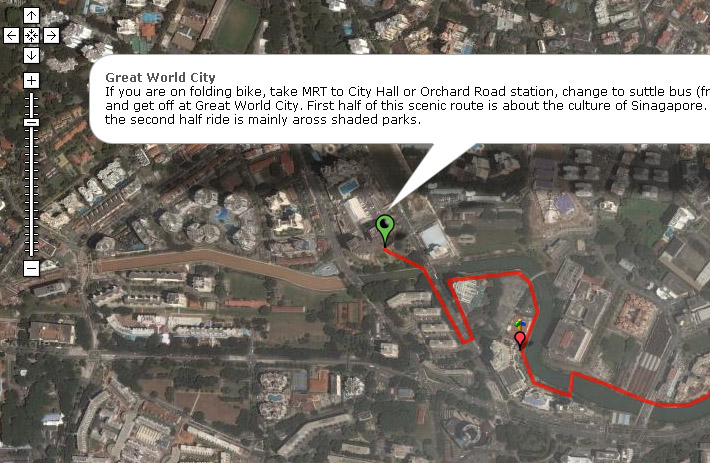
bikely.com

Stop dreaming of a cycling map for Singapore, start helping to build one by sharing your favorite on this site:

www.bikely.com

Already a few Singapore routes are there:

Signing up is easy, just fill in your user name, password and email here:

http://www.bikely.com/join

You will have immediate access to create new route.
Simple steps to create new routes:

1) click on the “submit route” menu along the top of page

2) select Draw it on the map using your mouse »

3) you will be seeing a google earth map, on the left of the map is the instruction:

First, enter “Singapore” into the search box, hit search and click on “singapore”, the google earth map will move to show Singapore.
To start drawing, hit the Create Route button above (ALT-C).
Drag the map to navigate it, or use the arrow keys. + & – zooms in and out. Navigate the map so that it shows the starting point of your ruote.
4) To start adding points to your path, simply click on the map. You can still drag the map around as normal.
If you make a mistake, press ALT-X (or the X button below) to delete the selected point.
To save your route, hit the Save Route button at the top right of the screen. Save your path regularly during its construction.

5) when you first save your route, you will be given the opportunity to name your route and have the choice of making it Visible to all or Under construction (hidden).

More detail instructions can be found here:
http://www.bikely.com/tutorial

So what are you still waiting for, create your cycling route now!