All posts by folder2

1st experience of JZ88

I intended to take a bus to school that day with my bike (JZ88), but on the way while cycling to the bus stop I met a fellow Pastor who’s on her way to a meeting near my school. So she suggested giving me a ride, I agreed and folded the bike into the car boot in less than 5 mins. This surprised her that the bike can go into the boot so well and there is space even for my bag and hers.

She dropped me off at her place of meeting which is about 5 km from my school, I took out the bike and ride it and on the way I felt the tire was soft and stopped at Mobile station to pump it up. It was uneventful the ride, but the usual concern when I was going uphill, the bike’s cranking sound is louder, I guess the weight of my books and myself combined is straining it. (I’ll be putting all my stuff into a locker at school soon and will only take along my mini EEE PC computer and a water bottle.)

I had to go to Pasir Ris for another appointment at night, but somehow I bumped into another Pastor at the school and he agreed to give me a ride down. (You see, Pastors are always obliged to be helpful…hee hee), and I got a ride to my next destination in a car!

After the meeting, I was tired, and it’s ten at night, I sighed at the thought of getting the bike on and off the bus, but to my surprise, the bike’s ability to stand up on its own after I folded it to the smallest size means I don’t need to even hold the weight of it. Then when the bus arrived, I just lift it up like a medium sized bag. I carried it right to the back row of the bus and sat down there. By the time the bus reached Tampinese Bus Interchange from Upper Serangoon Road there were few people on the bus, so I unfolded it quickly before the bus comes to a full stop and could ride off the bus immediately to the surprise of some by-standers at the interchange. (I bet they’ve not seen someone coming down from a bus with a bike!)

Cycling quickly to the Tampines MRT station, I decided to wheel in the bike by bending it by half but keeping the seat post and the handlebar upright, Then trolley like I wheel it in, under the glare of the station master but nobody stopped me. On the MRT I wheeled it to a corner near the other end of the door and since it is about 11pm I had all the seats to myself but didn’t take any. I wheeled the bike out when I came to the stop I wanted and just ride off back home after that. Reached home by 11:10pm!

My family thought I’ll take longer, but I didn’t.

Thanks for the bike, it’s amazing. I may have to put off more weight first cycling long stretches with my racer bike before I can load more weight on that tiny one. But it did accomplish the use it was for.

Oh another thing, the hills that I encountered (they are about 5 stories high at the max) and the incline that it is at, I cannot go up without getting off the bike. It’s ok, no big deal, the ride down was very fast but I felt stable and not wobbly. Good bike.

Yours,
Bill
———————————————————–
Thanks to Bill (Not his real name) for his permission to publish his post in this blog
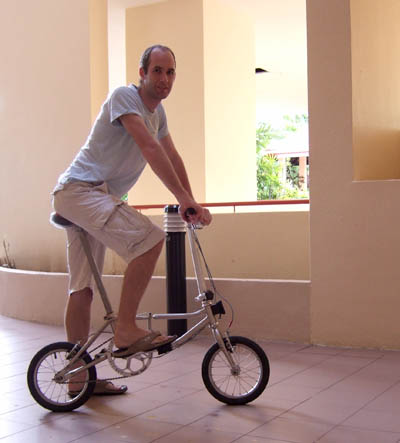
Try the bike!

David Bignold

I have enjoyed my trial of the JZ88, it has shown that it is possible and enjoyable to cycle to the office and to get some exercise. The bike is well built and quite capable both on the roads of Singapore and on the pavements. On the roads, it is capable of quite reasonable speeds as well as being small and maneuverable which helps on the pavements, best of all though it’s nice to be able to get fresh air commuting along the river path rather than being packed into a crowded MRT carriage. I would recommend that anybody try the JZ88.
— David Bignold 2008 Jan

Mini-roundabout or cross junction?

Just found this excellent video from Youtube showing an innovative idea, may be strange to Singaporean but quite common in Europe, call a mini-roundabout.
The idea is counter intuitive for those who are used to follow the traffic lights at traffic junction. The idea of mini-roundabout to resolve conflict at traffic junction is based on the same principle as indicated in yesterday’s post (Vision Zero), that in locations with possible conflicts between pedestrians and cars, the speed of cars should be reduced to below 30km/h. Here the system designer is not relying on traffic signs and speed camera. It is the physical environment design that ensure when cars approach the roundabout, their speed will have to be reduced to below 30km/h.

How does the system designer do that?
1- by making the roundabout small in size. When car need to make a small turn, they have to slow down.
2- by ensuring open visibility of on coming traffics from all direction, that provide time space for the drivers and other road users to negotiate with each other.
3- by marking the road so that it is very narrow as approaching the junction- this provide a safety-island for pedestrians who need to cross, and at the same time further ensuring the cars are slowing to a safe speed.

All of the above factors contributed to the effectiveness of the solution, no traffic light, nor even signs. The principle is to remove the traffic signs so that the drivers can focus on the road and other road users to ensure safety of everyone.

Since there is no traffic light to control the traffic, the surprising result is that the traffic flow is better and safer around such sign-less junctions. Here is another example comparing two types of junction:

Here is another Youtube video showing some car accident on traffic camera. It shows how dangerous cross junction can be due to difference in speed, even in safe Japan. I feel really sad for the little kid cycling cross a small road and got crashed by a car. This is exactly the kind of situation system designer can helps to avoid by designing the space right for human being, not just for automotive.

Yet another example from Holland, this time showing how a cyclist safely ride through (from far left to far right, from 11 sec. onward) the roundabout and many moving cars without a single stop.

Vision Zero

I attended the Road Safety Conference today in Vivo City. The keynote speech was delivered by Dr. Kent Gustafson, the Research Director of the Swedish National Road & Transport Research Institute. He explained the motivation and the on going development of “Vision Zero”- a human-centered approach to road safety policy and planning.
“Vision Zero” was established in 1997 to guide the transport policy and strategies. It highlighted that system designer need to take a bigger responsibility towards road safety and must follow the “Ethical rules”:

  • Life and health can not be exchanged for other benefits within the society.
  • Whenever someone is killed or seriously injured, necessary steps must be taken to avoid a similar event.
  • This approach is contrary to the common practice of only blaming the road users when accident occurs. Indeed, I thought, if architects must carry a heavy responsibility to the safety of the buildings they design, it only make sense that the system designer should be make responsible for their road design for the public.
    Based on these “ethical rules”, the bio-mechanic capacity of human body to tolerate impact during accident become the limiting factor for speed in any new system. In other word, the speed of any part in the system can only be as fast as the safety can be ensured.

    A list of “best practice” in this Vision Zero about types of infrastructure and related speed limites:

    Locations with possible conflicts between pedestrians and cars (30 km/h)
    Intersections with possible frontal impacts between cars (50 km/h)
    Roads with possible frontal impacts between cars (70 km/h)
    Roads with no possibility of a side impact or frontal impact between cars (100+km/h)

    Read more about Vision Zero

    —————————————————-
    In addition, Prof. Chin Hoong Chor shared an insightful study about the cost of traffic accidents in Singapore. It was concluded that the total cost (lost of human productivity, damage, and human lost-as calculated by court) of a fatal accident is ~SGD800,000 and ~SGD200,000 for a typical serious accident.

    His presentation was very much underscored by an victim (sorry, name forgotten) sharing his personal experience of a traffic accident last year.

    —————————————————-
    Mr. Ho Seng Tim of LTA presents how road safety has improved over the years in Singapore. A lot has been done from infrastructure, equipment to education. These efforts help Singapore to become one of the safest place to drive. I do wish more emphasis will be put on the “other” road users. Examples like Bus stop bollards, school warning zone are good start. I would like to see more of such infrastructure improvement to safe guard road users other then drivers. One problem I share with Mr. Ho after the conference is the danger at the traffic-light signaled cross junction. As a pedestrian, you should NOT cross when you see the green figure, you must first check your right side to be sure there is no car turning into you way before you can cross safely. This arrangement obviously put the convenient of drivers ahead of the safety of pedestrian (including school kids and elderly). Since all traffic light are programmed by computer, I asked if it is possible to experiment other safer timing option for the signal, Mr. Ho confirmed that is technically feasible 🙂

    Cycling as a form of health insurance

    My daily commute by bicycle is the best health insurance I can think of. No insurance policy can guarantee my health in the future, at best insurance can only cover the medical cost when my body goes wrong. Such scenario is far from desirable, I don’t want to get pay because of getting sick, I want my health.

    On the contrary, pedaling my bike is promoting the critical circulation systems in my body, bringing the essentials to where they are needed and at the same time, carrying the waste out of my body (sweating is good for me!). Statistically speaking, my body condition is similar to those 10 years younger. I can enjoy different types of food, I can enjoy to play catching with my kids while others of my age would rather watch.

    I believe the idea of insurance has been over sold. Many are concern that they don’t have enough to cover their old age medical bills because that’s what statistic suggested. But most people do not relate this to another piece of statistic, which shows nowadays 6 out of 10 are slowly losing their condition due to lack of exercise. The minority practicing daily exercise is belongs to another group, which stays fit and require less medical care. Therefore as long as I keep cycling everyday, I am not too worry.